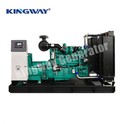
Hey there! As a supplier of high - end diesel generators, I often get asked about how the noise reduction technology in these machines works. It's a pretty cool topic, and I'm excited to break it down for you.
First off, why is noise reduction so important in high - end diesel generators? Well, in many situations, a noisy generator can be a real nuisance. Whether it's for use in a residential area, a hospital, or a telecommunication site, a quiet generator is a must. That's where our high - end diesel generators with advanced noise reduction technology come in.
The Basics of Noise in Diesel Generators
Before we dive into how the noise reduction technology works, let's understand where the noise in diesel generators comes from. Diesel generators are complex machines with a lot of moving parts. The main sources of noise are the engine combustion, the exhaust system, and the mechanical vibrations from the moving components like pistons, crankshafts, and gears.
The engine combustion process is like a mini - explosion happening inside the engine cylinders hundreds of times per minute. This explosion creates a high - pressure wave that travels through the air and causes a loud noise. The exhaust system also contributes to the noise as the hot gases are forced out at high speeds. And then there are the mechanical vibrations. Every time a piston moves up and down or a gear rotates, it creates a small amount of vibration. When these vibrations are combined, they can produce a significant amount of noise.
Exhaust Silencers
One of the key components in the noise reduction technology of our high - end diesel generators is the exhaust silencer. The exhaust silencer is designed to reduce the noise coming from the exhaust system. It works on the principle of sound absorption and reflection.


Inside the exhaust silencer, there are usually a series of chambers and baffles. When the high - pressure exhaust gases enter the silencer, they are forced to pass through these chambers. As the gases move through the chambers, their energy is dissipated. The baffles are designed to reflect the sound waves back and forth, causing them to cancel each other out. This reduces the overall noise level of the exhaust.
Our high - end diesel generators are equipped with specially designed exhaust silencers that are highly efficient in reducing noise. These silencers are made from high - quality materials that can withstand the high temperatures and pressures of the exhaust gases. They are also engineered to optimize the flow of exhaust gases, ensuring that the generator operates at peak performance while keeping the noise down.
Enclosure Design
Another important aspect of the noise reduction technology is the enclosure design. The enclosure of our high - end diesel generators acts as a physical barrier between the noisy engine and the outside world. It is made from thick, sound - insulating materials that absorb and block the sound waves.
The enclosure is not just a simple box. It is carefully designed to have a tight seal to prevent any sound leakage. It also has ventilation holes to allow air to flow in and out of the generator to keep it cool. But these ventilation holes are designed in such a way that they do not compromise the sound - insulating properties of the enclosure.
There are different types of enclosures for our high - end diesel generators. For example, check out our Super Silent Diesel Generator Set. It has a super - silent enclosure that is specifically designed to reduce noise to an extremely low level. The Standard Containerized Silent Diesel Generator is another great option. Its container - style enclosure not only reduces noise but also provides protection against the elements. And for telecommunication sites, we have the Telecommunication Silent Diesel Generator, which is designed to meet the strict noise requirements of these sensitive areas.
Vibration Isolation
Mechanical vibrations are a major source of noise in diesel generators. To reduce the noise caused by vibrations, our high - end diesel generators use vibration isolation technology. This technology involves using special mounts and dampers to isolate the engine and other moving components from the generator frame.
The mounts are made from materials like rubber or similar elastomers that can absorb the vibrations. When the engine vibrates, the mounts stretch and compress, converting the vibration energy into heat energy. This reduces the amount of vibration that is transferred to the generator frame and ultimately to the surrounding environment.
In addition to the mounts, dampers are also used to further reduce vibrations. Dampers are devices that resist the motion of the vibrating components. They work by providing a counter - force to the vibrations, which helps to stabilize the moving parts and reduce the noise.
Sound - Absorbing Materials
Inside the enclosure of our high - end diesel generators, we use sound - absorbing materials to further reduce the noise. These materials are designed to absorb the sound waves and convert them into heat energy.
Common sound - absorbing materials used in our generators include fiberglass, mineral wool, and foam. These materials have a porous structure that allows the sound waves to penetrate and get trapped inside. As the sound waves travel through the pores, they are absorbed and their energy is dissipated.
The sound - absorbing materials are strategically placed inside the enclosure to maximize their effectiveness. They are usually lined on the walls, ceiling, and floor of the enclosure to create a sound - deadening environment.
Active Noise Control (ANC)
Some of our most advanced high - end diesel generators are equipped with Active Noise Control (ANC) technology. ANC is a cutting - edge technology that uses microphones and speakers to cancel out the noise in real - time.
Here's how it works. The microphones are placed inside the generator enclosure to detect the noise. They then send a signal to a control unit, which analyzes the noise pattern. Based on this analysis, the control unit generates an anti - noise signal that is the exact opposite of the detected noise. This anti - noise signal is then sent to the speakers, which emit the anti - noise into the enclosure. When the anti - noise meets the original noise, they cancel each other out, resulting in a significant reduction in the overall noise level.
Conclusion
So, there you have it! That's how the noise reduction technology in our high - end diesel generators works. From exhaust silencers and enclosure design to vibration isolation, sound - absorbing materials, and even Active Noise Control, we use a combination of these technologies to ensure that our generators are as quiet as possible.
If you're in the market for a high - end diesel generator with excellent noise reduction capabilities, I'd love to have a chat with you. Whether you need a generator for your home, a business, or a telecommunication site, we have the perfect solution for you. Feel free to reach out and let's start the conversation about how we can meet your power needs while keeping the noise to a minimum.
References
- Diesel Generator Technology Handbook
- Noise Reduction in Industrial Machinery: Principles and Practices