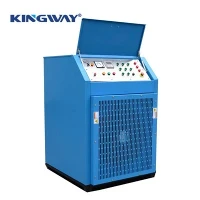
If you’ve ever wondered what happens when a data center’s backup generators need a final test before a critical launch, or when a hospital’s emergency power system is being validated ahead of a storm, you’ve likely crossed paths with load banks. As a supplier focused on 500KW load bank solutions, I’ve spent the last 12 years walking alongside engineers who rely on this equipment to avoid costly, dangerous power failures—so let’s break down exactly how a 500KW load bank works, and why our specific line of these units stands out for real-world use cases.
First, let’s ground this in a basic truth: power systems (generators, inverters, UPS units) are only as reliable as their ability to handle a full, consistent load. A generator that’s only ever idling at 10% capacity will develop carbon buildup, corrode internal components, and never reach its rated output—until the day you actually need it, and it underperforms. Load banks solve this by creating controlled, artificial electrical loads that mimic real-world demand, letting operators test every part of a power system without risking disruptions to live infrastructure.
A 500KW load bank sits in a sweet spot of size and flexibility. It’s not so big that it requires a dedicated semi-truck and crane to move (unlike massive 2MW units), but it’s powerful enough to test medium-scale systems: a 400,000 sq ft warehouse, a mid-sized cellular tower farm, a 10,000 sq ft medical office complex, or a data center satellite with 10-15 racks. It’s a workhorse for both temporary on-site testing and permanent setups for regular maintenance. If you need smaller units for lighter loads, our line also includes a 100kwPortable Load Bank for smaller generators or periodic spot checks. For larger-scale projects, our 2800KW 3500KVA Load Bank handles heavy industrial and mega-data center testing, so we can cover every size gap between those two extremes.
Now, let’s get into the nuts and bolts of how a 500KW load bank actually operates. The core design boils down to three key systems: a load generation assembly, a cooling system, and a control interface—each engineered to deliver consistent, precise power testing without overheating or failing mid-job.


The heart of the unit is its load element, which for most industrial 500KW load banks is a set of resistive heating elements made from nickel-chromium (Nichrome) alloy. This material is chosen because it has a high melting point, resists corrosion, and maintains consistent resistance when heated—critical for keeping test conditions accurate. When AC power from the generator (or whatever unit you’re testing) flows into the load bank, it passes through these Nichrome coils, which convert the electrical energy into heat. That heat is then dissipated, usually via an integrated fan or connected to an external exhaust system if working in tight indoor spaces.
Wait, you might be thinking: if it’s just turning power into heat, how does it simulate different types of real-world load? That’s where the design of the load elements and their switching comes in. A 500KW load bank is divided into individual, switchable load banks (most often 10KW to 50KW segments, depending on the model). Operators can turn segments on or off to dial in exactly the load they need—say, 300KW for a partial test, or the full 500KW for a full-load validation. Some more advanced models also offer reactive load functionality, but for basic generator testing (the most common use case for 500KW units), resistive load is the standard because it directly matches the power factor of most commercial and industrial loads.
Next, the cooling system is non-negotiable. When a 500KW load bank is running at full capacity, it’s generating enough heat to warm a small home in an hour. For comparison, a standard space heater is 1.5KW—so a full 500KW load bank produces the same heat as 333,000 space heaters. If that heat isn’t removed quickly, the Nichrome coils would overheat, break, or trigger a safety shutdown mid-test. Our 500KW units use two cooling stages: first, variable-speed axial fans that move cool air across the coils (adjusting speed based on load—slower for partial loads, faster for full 500KW runs) and, for indoor or enclosed use, an integrated heat exchanger that can connect to a building’s HVAC system to exhaust heat safely without blowing hot air into the work area. This is a feature I’ve seen save more than a few contractors from being shut down by building fire codes during testing.
The control interface is what makes the load bank useful, not just a pile of coils and fans. Modern 500KW units (including our own line, linked at 500KW Load Bank) have two control options: a local touchscreen on the unit itself, and remote monitoring via Bluetooth or Wi-Fi, so engineers don’t have to stand next to a noisy, hot unit during a 4-hour generator test. The control panel lets you set a specific load (e.g., 50KW for 2 hours, ramping up to 500KW over 30 minutes) and monitors critical metrics in real time: voltage, current, power factor, frequency, and internal temperature. It also has built-in safety protocols that shut down the unit automatically if something goes wrong—like overheating, a power surge, or a faulty connection. For example, if the generator being tested has a voltage spike that could damage sensitive equipment, the load bank will adjust its load segments (or shut down) to protect both itself and the power system.
Let’s walk through a real-world example of how this works in practice, because technical specs mean nothing without context. Last quarter, we worked with a Midwest-based regional hospital that needed to test its new 600KW backup generator ahead of a mandatory annual inspection by the state’s health department. The hospital’s facility manager didn’t want to take the generator offline for too long, and they needed to prove the generator could handle its full load without dropping below the required 120/208V for life support systems. Our 500KW load bank was perfect here—its capacity is just under the generator’s rated 600KW, so it could test almost the full load without overtaxing the new unit.
The team showed up at 7 a.m., when patient volumes were lowest. We connected the load bank’s input cables to the hospital’s generator transfer switch, and ran the exhaust hose to a loading dock vent to avoid heating the mechanical room. Using the remote control app, we set the test to ramp from 0KW to 500KW over 20 minutes, hold for 3 hours, then ramp down. For the next 3 hours, we monitored every metric: the generator’s voltage stayed within 1% of the rated 480V, frequency held steady at 60Hz, and oil temperature never exceeded the manufacturer’s threshold. The safety features kicked in once, when a loose connection caused a minor voltage drop— the load bank automatically adjusted its segments to stabilize the generator until the connection was fixed. By 10:30 a.m., we had a full test report, the hospital passed their inspection, and didn’t miss a single patient procedure as a result.
That’s the value of a 500KW load bank: it’s not just a test tool, it’s a way to de-risk critical infrastructure. A common misconception we hear is that load banks are only for new installations, but 70% of our sales are for regular maintenance—generators that are tested every 1 or 2 years to ensure they’ll work when called upon. Without that consistent load, generators develop what’s called “wet stacking,” a condition where unburned fuel builds up in the exhaust system, reducing efficiency and shortening the unit’s lifespan. A 500KW load bank running a full load test burns off that excess fuel, keeping generators running reliably for 10, 15, even 20 years longer than they would without regular testing.
Now, let’s talk about what makes our 500KW units different from others on the market, because as a supplier, I don’t just sell equipment—I solve problems. For example, many lower-cost 500KW load banks are only designed for outdoor use, but our models have NEMA 3R enclosures that meet indoor and outdoor standards, so you can use them in a tightly wired mechanical room or a rainy construction site without modifications. We also include a portable wiring kit with every unit, so you don’t have to rent extra cables or adapters to connect to different transfer switches or generators. And unlike some brands that force you to buy proprietary maintenance parts, our Nichrome coils, fans, and control panels are standard off-the-shelf components that any electrician can source, cutting downtime if a part needs replacing during a project.
We also prioritize safety above all else, which is why all our units are UL-listed and meet OSHA requirements for industrial equipment. That’s non-negotiable—we’ve heard horror stories of contractors using unapproved load banks that caused fires or damaged generators, so we build every 500KW unit with redundant safety systems: temperature sensors on every load segment, over-current protection, and a manual emergency shutoff that’s easily accessible in case of an emergency.
If you’re reading this, chances are you’re in the market for a 500KW load bank, or you’re just starting to research how to test your backup power system. Whether you’re a general contractor looking for a unit to rent for a few weeks, a facilities manager needing a permanent test solution, or an engineer working on a new industrial project, our team can help you pick the right unit for your needs. We don’t push one-size-fits-all solutions—if you only need a small unit for occasional testing, we’ll point you toward our 100kwPortable Load Bank instead of upselling you a 500KW model you don’t need. For larger projects, we can even pair our 500KW units with our 2800KW 3500KVA Load Bank to cover multi-stage load testing.
Our line of 500KW load banks is detailed in full at our product page: 500KW Load Bank, where you can find technical specs, user testimonials, and pricing for new and rental units. If you have questions about sizing, testing protocols, or delivery timelines, our team of power system experts is here to help. Don’t wait until a power outage or an inspection deadline to test your infrastructure—reach out to us today to discuss your load bank needs, and we’ll help you get the reliable equipment you need to keep your operations running.
References
- Load Bank Basics: Core Components and Applications, Power Systems Technology Association, 2022.
- Generator Wet Stacking: Causes, Prevention, and Mitigation, International Brotherhood of Electrical Workers, 2021.
- ANSI/UL 2200: Standard for Stationary Engine Generator Assemblies, Underwriters Laboratories Inc., 2020.
- Load Bank Safety Standards for Industrial Power Testing, Occupational Safety and Health Administration (OSHA), 2023.